
Exciting Developments in Kidney Disease: A Summary of Stem Cell Therapy Research
A summary and commentary on: Čižman B, Butler EL, Stavas J, et al. A Randomized Clinical Trial of Kidney Autologous Cell Therapy in Diabetic Kidney Disease. Clin J Am Soc Nephrol. Published January 2, 2026. doi:10.2215/CJN.0000000969
So if you have not heard, there has been some excitement in the world of kidney disease lately! An article came out in January 2026 discussing a possible and promising use of stem cell therapy to address diabetic kidney disease.
Why Are We Excited About Stem Cells?

Stem cells are special cells, often referred to as “baby cells,” that have not matured yet. They can replicate themselves and develop into any kind of cell in the body. We already use them in medicine, particularly in blood and bone marrow transplantation. They may soon help repair damaged tissues, reduce harmful inflammation, and improve how we model diseases and test drugs. The near future of stem-cell medicine is promising, especially in regenerative medicine and immune regulation. However, most new uses still require careful clinical trials to confirm safety and real benefit. This is what makes the recent article so exciting!
A recently published phase 2 trial in CJASN (Clinical Journal of the American Society of Nephrology) is generating genuine interest in nephrology circles and pushing the boundaries of our abilities. The study tests rilparence, an autologous kidney-derived cell therapy harvested by biopsy and injected directly into the kidney cortex in patients with diabetes and chronic kidney disease. This is a genuinely novel approach in a field where most therapies slow progression but do not plausibly repair anything.
What Was Studied?
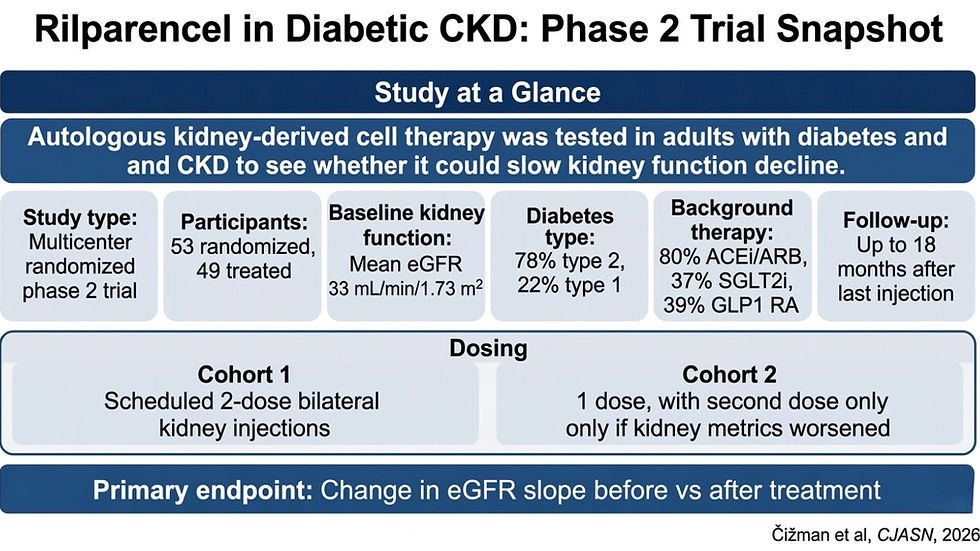
The trial enrolled 53 participants across five US sites, of whom 49 received at least one injection and were included in the analysis. This was a moderate-to-advanced CKD population: the mean baseline eGFR was 33 mL/min/1.73 m² (CKD Stage IIIb), and the median UACR was 421 mg/g (A3).
78% had type 2 diabetes
22% had type 1 diabetes
Background kidney-protective therapy was reasonably solid for the study period:
80% were on ACE inhibitors or ARBs
37% were on SGLT2 inhibitors
39% were on GLP-1 receptor agonists
The cohort was predominantly White (88%) and male (69%).
Participants were randomized into one of two active dosing strategies, not to placebo.
Cohort 1: Received scheduled bilateral treatment; one rilparencel injection into each kidney, approximately three months apart, with 96% ultimately receiving both doses.
Cohort 2: Received an initial injection, and a second dose only if a sustained eGFR decline or rise in UACR occurred; 60% ended up receiving a second injection, with a median interval of 11 months between doses.
The primary efficacy endpoint was the within-patient change in eGFR slope from the pre-injection period to the post-injection period. This design choice carries important implications, which I will discuss below.
What the Trial Found
The headline result comes from Cohort 1. The annual eGFR slope improved from -5.84 to -1.27 mL/min/1.73 m²/year, a difference of +4.57 mL/min/1.73 m²/year (95% CI 1.95 to 7.18). This means that kidney function improved. That is a large enough signal to make most nephrologists stop and look twice.
In Cohort 2, the slope improved from -3.40 to -1.71 mL/min/1.73 m²/year, a difference of +1.70 (95% CI -0.24 to 3.63). This result is directionally favorable, but not definitively so based on the confidence interval.
The absolute mean eGFR change from baseline after the last injection remained modest: Cohort 1 lost approximately 0.8 to 2.2 mL/min/1.73 m² through 18 months, while Cohort 2 lost approximately 2.1 to 2.9 mL/min/1.73 m².
Hard kidney endpoint event counts were low, limiting further interpretation:
Sustained ≥40% eGFR decline occurred in 17% of Cohort 1 and 8% of Cohort 2.
Progression to eGFR <15 or kidney replacement therapy occurred in 17% and 16% (C1, C2), respectively.
Albuminuria was not a convincing strength of the therapy, and no consistent effect on urine albumin excretion emerged.

Safety: Not Trivial, But Acceptable
Across 87 injections:
31 procedure-related treatment-emergent adverse events occurred in 16 participants (33%).
14 product-related events in 6 participants (12%).
Three participants experienced six biopsy-related serious adverse events, including:
- Subcapsular kidney hematoma (blood collection under the top layer of the kidney).
- Acute kidney injury (AKI).
- Hematuria with hydronephrosis (blood in the urine with kidney enlargement probably from blockage due to a blood clot).
- One participant had an injection-related subcapsular hematoma.
There were no product-related serious adverse events and no procedure or product-related deaths. The investigators note that biopsy-related event rates were comparable to those reported in similar CKD populations undergoing native kidney biopsy. Even so, this is not a pharmacologically simple intervention; it requires kidney biopsy plus cortical injection. The safety discussion is procedural in nature, not just pharmacologic.

Where the Trial Is Strong — and Where It Struggles
The trial’s most compelling feature is what it is testing. A regenerative, autologous cell approach is fundamentally different from another hemodynamic or metabolic modifier. The magnitude of slope improvement in the scheduled bilateral cohort is large enough to sustain attention. The investigators also enrolled a genuinely high-risk population on relatively contemporary background therapy, so the signal did not arise against an undertreated comparator.
The most significant limitation is structural. This was not a parallel-group, placebo-controlled trial. The primary efficacy claim rests on comparing each participant’s historical pre-treatment eGFR slope with their post-treatment slope, using data that included chart review. That design is vulnerable to numerous changes when calculating the results, and all the authors acknowledge this explicitly.
The sample was also small, clinical events were few, the two cohorts had meaningful baseline differences (notably higher UACR in Cohort 1), and the study was conducted at five US sites with a predominantly White male population, limiting generalizability.
Several authors are affiliated with ProKidney, the company developing rilparencel, and sponsorship bias must be taken seriously when interpreting a favorable phase 2 signal.
The Bottom Line
The authors conclude that bilateral kidney administration of rilparencel was associated with slowing CKD progression and that the safety profile was acceptable.
What this paper does usefully establish is that dose intensity and timing appear to matter. Any meaningful effect seems to operate on eGFR trajectory rather than albuminuria. The approach is procedurally feasible, however invasive. If the phase 3 trial confirms benefit, the eventual niche will almost certainly be high-risk diabetic kidney disease patients with progressive GFR loss despite contemporary therapy, not broad first-line use. The biopsy-and-injection logistics alone make rilparencel a very different kind of intervention than adding finerenone or semaglutide. For now, it is worth watching closely.
Exciting times ahead!


