
Understanding the Impact of CKD on Sexual and Reproductive Health
Updated: Feb 13
Within the world of CKD, physicians and patients often focus on basic CKD complications such as complications with diabetes, difficult-to-control hypertension, and an elevated risk of cardiovascular disease. However, one of the most impactful and difficult topics to discuss is sexual and reproductive health. As I have written before, CKD is a condition that influences multiple systems, and this area of health and wellness is not immune to the dysregulation that CKD can cause.
Simply put, CKD profoundly disrupts sexual and reproductive health in ways that extend far beyond laboratory values and clinical measurements. Its impact on social and emotional factors is notable. For both men and women living with CKD, the effects on intimacy, fertility, and sexual function represent one of the most distressing yet under-addressed aspects of the disease. Understanding these gender-specific manifestations is essential for comprehensive kidney care. Treatment of other contributing conditions is important; however, the distress that occurs, often hidden under the guise of depression or anxiety due to implied taboos and sensitive topics, is no less important to overall health.
The Male Experience: Hormonal Decline and Sexual Dysfunction
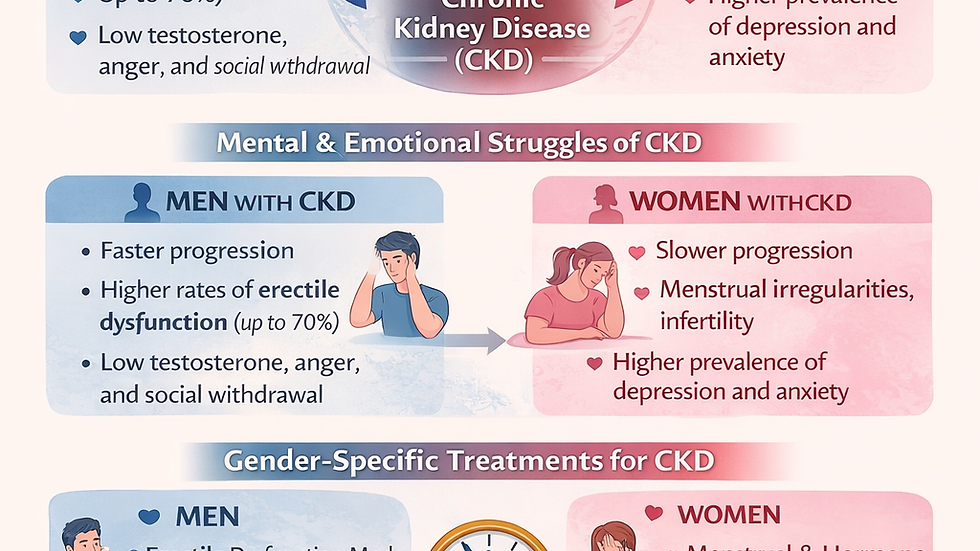
Men with advanced CKD face numerous challenges to sexual health rooted in hormonal imbalance and vascular compromise. Unfortunately, these early signs are often attributed to "getting older" and are therefore missed, never associated with the initial problem. Erectile dysfunction affects 70-80% of men with Stage 4–5 CKD, making it one of the most prevalent complications of advanced kidney disease.¹⁻³ This dysfunction stems from multiple mechanisms: testosterone deficiency becomes increasingly common as kidney function declines, while uremia damages the delicate vascular and neurologic systems essential for sexual function.⁴⁻⁶
The mechanisms involve a complex disruption of the hypothalamic-pituitary-gonadal axis (a key hormonal process), with hypogonadotropic hypogonadism occurring in 30-65% of men with advanced CKD (disruptions in this initial process lead to inadequate hormone production).⁶ Hyperprolactinemia from reduced renal clearance further suppresses gonadotropin-releasing hormone, compounding the hormonal dysfunction. In other words, a decrease in the ability to filter out compounds leads to the accumulation of hormones that work against the system.⁶ The psychological toll cannot be overstated; many men experience profound threats to their masculine identity and self-worth when confronted with sexual dysfunction.⁷ This creates a vicious cycle where depression and anxiety further suppress libido and sexual performance, only adding to the biological challenges already present. Depression correlates independently with erectile dysfunction in hemodialysis patients, and up to 45% of men on dialysis report significant depressive symptoms.⁸

Management Strategies for Men
Management requires a multi-point approach that addresses both physiological and psychological dimensions. Phosphodiesterase-5 inhibitors like sildenafil (Viagra) may be effective for erectile dysfunction, though dosing must be adjusted for reduced kidney function (among additional medications that may also be prescribed).⁹ Testosterone replacement therapy (TRT), when clinically appropriate and carefully monitored in confirmed hypogonadotropic states, can help restore hormone balance and improve sexual function.⁴⁻⁶ Careful monitoring of total and free testosterone along with PSA (Prostate Specific Antigen) is essential. Equally important is mental health counseling that helps men navigate the emotional impact of sexual dysfunction and challenges traditional masculine norms that often prevent men from seeking help. Couples therapy can be particularly valuable in preserving intimacy and communication during this difficult transition. Notably, kidney transplantation offers the best hope for restoration of function. Studies show erectile dysfunction prevalence drops from approximately 80% in dialysis patients to 30-50% following successful transplantation.⁶
The Female Experience: Reproductive Disruption and Diminished Well-Being
Women with CKD encounter equally profound, but distinctly different challenges to their reproductive and sexual health. Menstrual irregularities are nearly universal in advanced kidney disease, with approximately 60-75% of women on hemodialysis experiencing amenorrhea, oligomenorrhea, or irregular menses.¹⁰⁻¹² Women on peritoneal dialysis experience even higher rates of menstrual abnormalities (75%) compared to those on hemodialysis (19-47%).¹⁰ These disturbances result from disruption of the hypothalamic-pituitary-gonadal axis (the same hormone dysregulation as in men), with uremia leading to decreased estrogen and progesterone levels, increased luteinizing hormone, and lack of cyclic luteinizing hormone release necessary for ovulation.¹⁰
Infertility becomes common as CKD progresses, driven by multiple factors including reduced ovarian reserve, reproductive hormone disturbances, and gonadotoxic medications such as cyclophosphamide.¹¹⁻¹³ Recent prospective studies confirm that women with CKD demonstrate significantly elevated prolactin levels and reduced anti-Müllerian hormone (AMH), a key marker of ovarian reserve, compared to healthy controls.¹⁴ Perhaps most striking is the acceleration of menopause that CKD triggers. Women with kidney disease experience menopause approximately 4-5 years earlier than the general population, reducing the overall reproductive lifespan from approximately 37 years in healthy women to 32 years in those with CKD.¹⁰˒¹⁵ This early menopause compounds cardiovascular and bone health risks that are already elevated by CKD itself.
For women who do become pregnant with CKD, the risks escalate dramatically. Even mild CKD (serum creatinine <125 µmol/L) is associated with preeclampsia rates of 40%, preterm delivery in 54%, and small-for-gestational-age infants in 64% of pregnancies.¹⁶ Women with moderate to severe CKD face even worse outcomes, with preterm delivery rates reaching 86%.¹⁶ Preeclampsia risk increases incrementally with declining kidney function and proteinuria, requiring close collaboration between nephrology and obstetric specialists throughout pregnancy.¹⁷⁻¹⁹
Sexual dysfunction in women manifests through reduced libido, vaginal dryness, and dyspareunia (pain during intercourse), all stemming from hormonal changes, anemia, and the psychological burden of chronic illness.¹²˒²⁰ Body image concerns and social isolation further contribute to sexual dissatisfaction and reduced quality of life.
Management Strategies for Women
Management strategies for women must similarly address both biological and psychosocial dimensions. Topical estrogen preparations can alleviate vaginal dryness and discomfort, though systemic hormone replacement requires careful consideration given cardiovascular and thrombotic risks.²⁰ Body image counseling and relationship support programs help women maintain intimacy and self-esteem during disease progression. For women considering pregnancy, preconception counseling and fertility preservation discussions should occur early in the disease course, ideally before dialysis becomes necessary.¹¹˒¹³ Fertility preservation options include cryopreservation of oocytes, embryos, or ovarian tissue, particularly for women requiring gonadotoxic immunosuppression.¹³ High-risk obstetric monitoring becomes essential for any pregnancy in CKD stages 1-3.
A Shared Challenge Requiring Integrated Care
Across both genders, the impact of CKD on sexual health represents more than a collection of symptoms; it fundamentally reshapes identity, relationships, and quality of life. The exhaustion of dialysis schedules, dietary restrictions, and physical limitations erode spontaneity and intimacy. Depression and anxiety, reported in up to 47% of patients with predialysis CKD and reaching 92% in some hemodialysis populations, further suppress sexual interest and strain relationships.²¹⁻²³ Women consistently report higher rates of anxiety and depression than men with CKD, with significant negative correlations between psychological distress and quality of life across all domains.²²˒²⁴
Yet these issues remain chronically under-recognized in routine nephrology care. Studies consistently document that sexual and reproductive health concerns are inadequately addressed by nephrologists, with many clinicians reporting a lack of knowledge and confidence in this area.¹²˒¹³ This represents a critical gap in comprehensive kidney care. The solution lies in normalizing sexual health discussions within kidney care. Routine assessment of sexual function, inclusion of partners in care planning, and ready access to sexual health counseling should become standard practice in nephrology clinics.²⁰ When patients receive comprehensive sexual health support, research demonstrates improved quality of life, better treatment adherence, and stronger relationship satisfaction. Outcomes that matter as much as any laboratory value.²¹⁻²³ Early intervention, open communication, and gender-aware care remain our most powerful tools for preserving not just kidney function but the intimacy and identity that make life worth living.
Conclusion
In conclusion, the impact of CKD on sexual and reproductive health is profound and multifaceted. It is essential for healthcare providers to recognize and address these issues as part of a holistic approach to kidney care. By fostering open discussions and providing targeted support, we can help individuals navigate the challenges posed by CKD, ultimately enhancing their quality of life.
References
Navaneethan SD, Vecchio M, Johnson DW, et al. Prevalence and correlates of self-reported sexual dysfunction in CKD: a meta-analysis of observational studies. Am J Kidney Dis. 2010;56(4):670-685.
Palmer BF, Clegg DJ. Sexual dysfunction in men and women with chronic kidney disease and end-stage kidney disease. Adv Ren Replace Ther. 2003;10(1):48-60.
Pizzol D, Xiao T, Yang L, et al. Prevalence of erectile dysfunction in patients with chronic kidney disease: a systematic review and meta-analysis. Int J Impot Res. 2021;33(5):508-515.
Soykan A, Boztas H, Kutlay S, et al. Erectile dysfunction in chronic kidney disease: from pathophysiology to management. World J Nephrol. 2015;4(3):379-388.
Karakus S, Akdemir A, Karaman Erdogan F, et al. Chronic kidney disease and erectile dysfunction. Turk J Urol. 2014;40(4):202-207.
Finkelstein FO, Shirani S, Wuerth D, Finkelstein SH. Male sexual dysfunction and chronic kidney disease. Front Med (Lausanne). 2017;4:32.
Fu R, He P, Hong W, et al. Male sexual dysfunction in patients with chronic kidney disease: a cross-sectional study. Sci Rep. 2024;14(1):9207.
Peng YS, Chiang CK, Hung KY, et al. The association of higher depressive symptoms and sexual dysfunction in male haemodialysis patients. Nephrol Dial Transplant. 2007;22(3):857-861.
Soykan A, Boztas H, Kutlay S, et al. Erectile dysfunction in chronic kidney disease: from pathophysiology to management. World J Nephrol. 2015;4(3):379-388.
10. Ali N, Azam I, Munir S, et al. Reproductive health in women with kidney disease. Clin J Am Soc Nephrol. 2022;17(11):1704-1708.
11. Dumanski SM, Ahmed SB. Fertility and reproductive care in chronic kidney disease. J Nephrol. 2019;32(1):39-50.
12. Chang DH, Dumanski SM, Ahmed SB. Female reproductive and gynecologic considerations in chronic kidney disease: adolescence and young adulthood. Kidney Int Rep. 2021;7(1):4-15.
13. Ahmed SB, Vitek WS, Holley JL. Fertility, contraception, and novel reproductive technologies in chronic kidney disease. Semin Nephrol. 2017;37(4):327-336.
14. Dumanski SM, Corbett KS, Vora N, et al. Impact of CKD on female reproductive hormones. Kidney Int Rep. 2025;10(5):1198-1209.
15. Rytz CL, Dumanski SM, Ravani P, et al. Menstrual abnormalities and reproductive lifespan in females with CKD: a systematic review and meta-analysis. Clin J Am Soc Nephrol. 2022;17(11):1662-1673.
16. Williams D, Davison J. Pregnancy outcome in women with chronic kidney disease: a prospective cohort study. Reprod Sci. 2011;18(1):64-72.
17. Wiles K, Bramham K, Seed PT, et al. Reproductive health and pregnancy in women with chronic kidney disease. Nat Rev Nephrol. 2018;14(3):165-184.
18. Piccoli GB, Cabiddu G, Attini R, et al. Pregnancy in chronic kidney disease. Semin Nephrol. 2017;37(4):337-353.
19. Koirala P, Garovic VD, Dato MI, Kattah A. Role of chronic kidney disease and risk factors in preeclampsia. Pregnancy Hypertens. 2024;37:101146.
20. Dumanski SM, Eckersten D, Piccoli GB. Reproductive health in chronic kidney disease: the implications of sex and gender. Curr Opin Nephrol Hypertens. 2022;31(4):298-306.
21. Lee YJ, Kim MS, Cho S, Kim SR. Association of depression and anxiety with reduced quality of life in patients with predialysis chronic kidney disease. Int J Clin Pract. 2013;67(4):363-368.
22. Oweis AO, Alshelleh SA, Darawad M, et al. Prevalence of depression and anxiety with their effect on quality of life in chronic kidney disease patients. Sci Rep. 2022;12(1):17627.
23. Al-Taie MM, Al-Anbari MA, Ali HH. Level of depression and anxiety on quality of life among patients undergoing hemodialysis. SAGE Open Med. 2023;11:20503121231174754.
24. Khan A, Khan AH, Adnan AS, Sulaiman SAS, Mushtaq S. Gender role in anxiety, depression, and quality of life in chronic kidney disease patients. J Pak Med Assoc. 2016;66(9):1059-1063.


