
Understanding Creatinine and BUN: What Every Patient and Provider Should Know
Updated: Jan 29
Andrew Kowalski, MD, FASN
Here’s the “kidney labs 101” that we all wish every inbox message came pre-loaded with. When providers order basic metabolic panels, they’re typically looking at a few different electrolytes, serum creatinine, blood urea nitrogen, and the derived estimated glomerular filtration rate, that gets calculated from creatinine (and sometimes Cystatin C, another marker not related to muscle mass). While these seem straightforward on the surface, they’re routinely misinterpreted in ways that lead to unnecessary referrals, missed diagnoses, and inappropriate management decisions.
Let me walk you through what these markers actually tell us, where they come from, and most importantly, how to avoid the common traps that catch even experienced clinicians.
Creatinine: The Imperfect, but Needed Marker
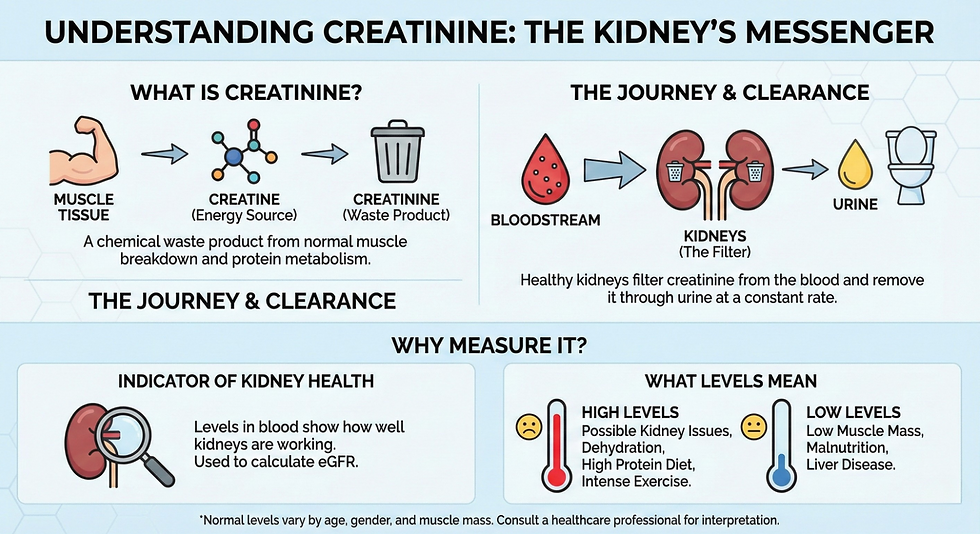
Creatinine comes from the metabolism of creatine and phosphocreatine in skeletal muscle. For any given person, it’s produced at a relatively steady rate, though this varies tremendously between individuals based on muscle mass, diet, illness, and other factors. Once produced, creatinine is freely filtered at the glomerulus and not reabsorbed by the renal tubules, though there is some tubular secretion that becomes increasingly relevant as kidney function declines. This marker and its system makes it useful as a kidney function marker, but it’s far from perfect.
Creatine…sounds familiar?
The creatine that we naturally make is the same supplement that athletes take to give them more energy during exercise.

So to summarize, our muscles constantly produce creatine and healthy kidneys filter it out of your blood and into your urine for elimination. The nice part about this system is that only the kidneys remove creatinine, so if everything is simplified, then the kidney can be treated like a simple water filter, When kidney function declines, the kidneys' ability to clear creatinine drops, and blood creatinine levels often rise.
What is important to understand is that creatinine is NOT a marker of kidney injury or damage. This is where most of the mistakes happen when looking at the blood work. I frequently give the example that if someone thinks they were having a heart attack, I could do a simple blood test and say “yes they are” or “no they are not.” That is not what creatinine is. Creatinine is a marker that tells nephrologist how well the kidney is filtering, not if it is damaged. So as you can probably guess the situation that the patient is in at the time of the blood test plays a HUGE role in changes in creatinine.
Now, if changes in filtration is compromised for a long period of time then there is a good chance that damage has also occurred, and then the change in creatinine (filtration) would suggest the change is because of damage. This is how we interpret how well the kidneys are doing when someone has Chronic Kidney Disease (CKD).
You would think that as medicine has improved so much over the years we would have better blood tests to look at kidney function. The short answer is that we do, but we use creatinine because it’s easy and cheap to measure, produced fairly continuously, and mostly cleared by filtration.
BUN: The Context Clue, Not the Answer
When looking at blood urea nitrogen (BUN) on the labs, that often tells a different story. Urea is produced in the liver through the urea cycle from ammonia generated by protein metabolism, both from dietary sources and tissue breakdown (when very sick or in the setting of starvation). The lab reports the nitrogen component of urea as BUN. Just like creatinine, we use it because it’s easy and cheap to measure, but it’s actually a worse kidney marker than creatinine because it’s heavily influenced by many other situations and and gets reabsorbed in the tubules, especially when the kidney is trying to conserve water (like when dehydrated).

BUN’s strengths lie in its ability to signal what else is happening physiologically (or what else is happening in the body). When BUN rises fast relative to creatinine, it can suggest pre-renal physiology (early dehydration), though this is far from being a “cut and dry” explanation. It can provide clues about GI bleeding, since digested blood has a significant amount of protein that will increases urea production. It also flags catabolic states (overall muscle breakdown) from steroids, serious infection, or tissue breakdown from other reasons, and can also reflect high protein intake, and if the BUN is very low can suggest an overall poor diet and minimal protein intake (like in starvation).
The limitations of BUN as a kidney function marker are relatively long. It varies wildly with protein intake, catabolism, GI bleed, liver function (patients with severe liver disease may have surprisingly low BUN), volume status and ADH effect, a hormone that the brain releases and more urea gets reabsorbed when the body is conserving water. A “high BUN” can scare clinicians into thinking about “uremia” when the patient is simply dehydrated or catabolic, leading to unnecessary alarm and testing.
Two words that might be thrown around and are good to understand are UREMIA and the lesser known AZOTEMIA.
AZOTEMIA: is a medical definition that notes abnormally high levels of nitrogen containing compounds, primarily urea and creatinine, in the blood. Typically this indicates poor renal filtering. It results from accumulated protein waste products, often caused by reduced blood flow to the kidneys; either poor blood flow to the kidneys (pre-renal injury), possibly something happening within the kidney (renal injury), or urinary tract obstruction (post-renal injury).
UREMIA: Uremia sometimes a serious and life-threatening condition due to high levels of urea and other waste products in the blood. This implies that kidney filtering has stopped, and cannot adequately filter waste, causing toxins to build up in the body. Immediate treatment, such as dialysis or a kidney transplant, is required.
Azotemia, simply put, is elevated levels of various toxins without the patient having symptoms. If these toxins remain elevated for about 3-7 days, depending on the person, they will begin to affect the brain and body leading to potentially serious complications, and that is called uremia.
What is the Estimated Glomerular Filtration Rate (eGFR) and is that the precent that my kidneys are functioning?
When creatinine rises, it often signals falling GFR, though the relationship isn’t as straightforward as many clinicians assume. As stated above, creatinine strengths are real and work well for tracking trends within the same patient over time, and when properly converted to eGFR and interpreted with clinical context (ie what is happing at that time), it provides valuable information about kidney function.
So what is eGFR and what is it not?
Your eGFR estimates how much blood your kidneys filter each minute, measured in milliliters per minute. To understand this number, imagine your kidneys as sophisticated water filters processing your entire blood volume multiple times per day. A normal eGFR is 90 or higher, though young and healthy adults often have values well above 100. As we age, eGFR naturally declines somewhat. It’s not uncommon for healthy people in their 70s or 80s to have eGFR values in the 60s without any actual kidney damage. This is a known age-related rate of decline. Similar to a pair of break pads, they will wear down if you use them. Based on studies from the 1950’s we know that the average rate of decline is about 0.5-1.0 milliliters per minute each year starting at about age 30.
You might be asking yourself now “when have I ever heard this term?” Or “my provider always give me a percentage when discussing kidney function.”
Talking about your kidney percent is a very common way of explaining the range your kidney are filtering at that nephrologists use. We inappropriately use eGFR as a precent value of your kidney function. It is much easier to understand that someone’s kidney function is at 40% verses your function is 40 milliliters per minute. Most other organ systems utilize a “percentage” to describe function, so naturally it would make it easier to understand kindney function as a percentage.
The eGFR is calculated using a formula that incorporates your serum creatinine, age, sex, and race. It's important to understand that eGFR is an estimate, not a direct measurement.
The limitations of eGFR are where things get interesting, and where most mistakes happen. Creatinine isn’t a direct GFR measurement, it’s a substitute influenced by multiple non-kidney factors;
Muscle mass creates perhaps the biggest pitfall: patients with low muscle mass will have deceptively low creatinine levels and falsely reassuring eGFR values, while muscular individuals may have higher creatinine without any true kidney disease
Diet and supplements compound this problem. A meal heavy in cooked meat can transiently raise creatinine, and creatine supplements can elevate creatinine without any decline in actual GFR.
If taking creatine supplements, you HAVE to let your provider know as this will cause unnecessary stress and confusion for you both as you will have a elevated Creatinine and a drop in function, but in reality nothing is wrong. Your 11 cm long kidneys can only filter so much, so adding additional creatine—> creatinine will make your kidney function look worse.
Tubular secretion adds another layer of complexity, particularly in advanced CKD where secretion means creatinine overestimates GFR decline in less predictable ways.
Her is what this means. The kidney filters all of the toxins and build up in the body, we look at creatinine as a substitute…so if the creatinine remains elevated then the assumption is that the kidney is not filtering. Additionally, only about 80% of the body’s creatinine is filtered and the other 20% or so is added to the urine before it heads down to the bladder. So if there is an issue with creatinine secretion then a blood test will have/show more creatinine left over (about 20%) and when plugged into the eGFR equation will look like your kidney function is worse than it really is. So issues with secretion has no impact on how the kidney filters; this leads to normal kidney function with a blood test that looks like there is kidney disease. Medications like trimethoprim (antibiotic) and cimetidine (Tagamet) can raise creatinine by blocking tubular secretion without causing any real kidney injury..
See how the confusion just builds?
Creatinine also fails miserably when trying to see if there is real kidney injury, There is always a lag in creatinine. In the setting of real kidney injury, creatinine acts as a “rearview mirror,” meaning that the numbers that are seen today have nothing to do with what is happening now, but are a indication of what happened yesterday. Creatinine is filtered all day long and it is made all day long. So if something happens today to cause kidney injury then tomorrow’s numbers will likely be almost normal. It is the following days that will see the change in creatinine. Because of this lag, providers are always looking at yesterday’s kidney function, not today’s.
Why We Use Both: The Clinical Logic
The reason we measure both creatinine and BUN isn’t redundancy, it’s about getting complementary information. Think of it as if you were looking at a house on a website. The picture looks beautiful, you can start seeing yourself living there, but it is only one picture. Does it show the disaster that is the backyard? What if there is a huge hole in the wall? You won’t see these important parts because you are only looking at one image. The same process is involved when looking at and interpreting someone’s kidney function. The creatinine maybe ok, but what about the other values? What is happening or has happened to the patient? All of these puzzle pieces need to be put together in the setting that the provider is presented with or I can guarantee you that valuable information will be missed.
To bring it all together, creatinine answers the question “How is the kidney filtering” and serves as our best readily available estimator of GFR, especially when interpreted as a trend and calculated as eGFR. BUN, on the other hand, answers “What else is going on; hydration status, protein load, catabolism, GI bleeding?” It’s more of a physiology clue than a GFR estimator, and recognizing this distinction prevents a lot of clinical errors.
The Common Misinterpretations: Real-Life Examples from the Trenches
The first major error I see routinely is the assumption that “creatinine is normal, so kidneys are fine.” A “normal” creatinine can hide significant CKD in people with low muscle mass. Consider the frail older adult with a serum creatinine of 0.8 mg/dL, their eGFR might still be quite low, and they might have significant albuminuria that gets missed entirely because everyone stopped at the reassuring creatinine number. The correct approach is to always interpret creatinine in the context of eGFR, urine albumin or protein measurement, and trend over time.
The second trap involves minimizing small absolute changes in creatinine. When a patient’s creatinine goes from 0.9 to 1.2 mg/dL, it’s tempting to think “that’s only 0.3, so it’s minor.” But creatinine is nonlinear, a small absolute rise can represent a meaningful GFR drop, especially from a low baseline. A change from 0.8 to 1.2 mg/dL can represent a substantial relative change in kidney function. The correct frame is to look at percent change, clinical context, urine output, medications, volume status, and timing of repeat measurements rather than fixating on the absolute numbers.
The third common error is interpreting an elevated BUN as proof of kidney failure. BUN is easily elevated by dehydration, high-protein diet, steroid use, catabolism, or GI bleeding. A patient with a BUN of 45 mg/dL and creatinine of 1.0 mg/dL who’s on prednisone and a bit volume depleted isn’t in kidney failure, they’re catabolic and dry. High BUN does not equal uremia. The right question to ask is “why is urea being generated or reabsorbed more than usual?”
Fourth, while a BUN-to-creatinine ratio greater than 20 is suggestive of pre-renal azotemia (low blood volume from a number of reasons), it’s not definitive. Multiple other conditions raise BUN out of proportion to creatinine, including GI bleeding, protein loading, and catabolic states. Use the ratio as a clue, then confirm with history, volume examination, vital signs, and urine studies when appropriate.
Fifth, there’s the reflexive panic about creatinine rising after starting an ACE inhibitor or ARB. A modest rise in creatinine with these medications can be expected due to hemodynamic effects, specifically lower intraglomerular pressure, rather than structural kidney damage. A rise of up to approximately 30% is often tolerated depending on the clinical scenario, potassium level, and overall patient status. The exact threshold and management depend on context and specific guidelines, but the key point is that not every rise in creatinine means the medication must be stopped immediately. This has been proven in many research studies and providers need to move away from this old way of thinking.
Sixth, many clinicians treat eGFR as the definitive measure of kidney function, full stop. But eGFR is an estimate based on creatinine and built-in assumptions about muscle mass and creatinine generation. It’s less reliable at extremes of muscle mass, during acute illness, in pregnancy, and during rapid changes like acute kidney injury. The correct approach to diagnosing CKD requires duration (at least three months of abnormality), markers of kidney damage (especially albuminuria), and eGFR, not eGFR alone.
Finally, when creatinine rises, there’s often a rush to diagnose kidney injury. But many creatinine elevations are related to other causes; from volume depletion, reduced blood flow, or medications like NSAIDs (Ibuprofen), diuretics, RAAS inhibitors (ie Lisinopril or Losartan), or SGLT2 inhibitors. Other reasons might be as simple as a older man with urination issues pointing to a enlarged prostate (causes urine obstruction). Before assuming any type of kidney injury, don’t skip the basics: assess volume status, review the medication list, consider obstruction risk, and check the urinalysis.
The Nephrologist’s “Don’t Get Fooled” Checklist
When you see changes in creatinine or BUN, run through this mental checklist before jumping to conclusions.
Consider the trend and time course—are we talking about changes over hours, weeks, or months?
Think about the patient’s muscle mass and body size, as this fundamentally affects how you interpret creatinine
Assess volume status and blood pressure, since pre-renal physiology is incredibly common.
Ask about diet and supplements, particularly meat intake and creatine supplementation.
Review medications that affect creatinine secretion, like trimethoprim-sulfamethoxazole and cimetidine.
Get a urinalysis and urine albumin-to-creatinine ratio, which are often more informative than the serum numbers.
consider obstruction risk, especially in older men, patients with pelvic malignancies, or those with a history of kidney stones.
These markers are tools, not answers. When you understand what they measure, what influences them, and where they mislead us, you can use them effectively to guide patient care. When you forget their limitations, they become sources of confusion and error. The difference between the two approaches is clinical context, critical thinking, and a healthy dose of humility about what these simple blood tests can and cannot tell us about kidney function.


